
Weir Minerals outlines five tips for maintaining slurry pumps


Weir Minerals has made available alternative options to tackle maintenance of a slurry pump, which minimises downtime through the use of ready-to-install components.

While there are many options available to operators, choosing the right slurry pump maintenance strategy for a mine site requires careful consideration.  The most commonly used method is in-situ, which involves the service team taking the slurry pump apart there and then. Weir Minerals explores the key benefits of different strategies for maintaining slurry pumps.

Below are five ways to maintain Warman® pumps.

In-Situ Maintenance
The most common strategy is in-situ maintenance, where repairs are made and worn out components are exchanged right there on the spot.  As maintenance generally involves replacing key wear components within a Warman® pump’s wet end, in-situ maintenance often requires maintenance fitters to disassemble and subsequently reassemble the entire wet-end.

READ: Weir Minerals Africa unveils MCR 450 pump

This flexible approach is favoured for its lower initial cost, but is time and resource consuming during a shutdown, occupying lifting equipment and specialist maintenance fitters for up to 24 hours, depending on the work required and the pump’s size. This process also involves extensive direct man to equipment interface time.

Clamshell Maintenance
Compared to performing in-situ repairs, clamshell maintenance is significantly faster. Instead of disassembling a Warman® pump and replacing each component, the entire wet-end, or clamshell, is exchanged with a spare from storage.

This replacement significantly reduces the time of in-situ maintenance, freeing up vital cranes and personnel to work elsewhere during the shutdown, and reducing the impact of any unplanned maintenance required.

By simply exchanging the entire wet end of the pump on site, this method improves safety by minimising the direct interface between people and pump.

Following the shutdown, the removed clamshell can be safely refurbished in a more-controlled environment, leading to a higher quality rebuild in many cases.

RELATED: Maintenance tips for slurry pumps

Clamshell maintenance doesn’t consume any additional parts when compared to in-situ, although it does entail a larger initial investment to acquire the second suction cover, cover plate and frame plate which comprise a clamshell.

Bare shaft pump changeout
Similar to clamshell maintenance, bare shaft pump changes out the entire Warman® pump with a pre-prepared spare.

This shares the same advantages as clamshell maintenance, taking significantly less time to remove than in-situ maintenance, freeing up lifting equipment for other maintenance and minimising the potential for injuries and complications that in-situ maintenance can entail.

Bare shaft pump changeout does require extra capital investment, although that can be relatively modest when compared to the productivity gains from reduced periods of downtime compared to in-situ repairs. Similar to clamshell changeout, following the shutdown, the removed pump can be safely refurbished in a more-controlled environment.

As with other strategies, the application will determine whether the extra CAPEX is offset by OPEX reductions.

Back Pull Out (B.P.O.)
Some pumps are designed for the rotating assembly to be pulled out of the overall pump casing – enabling in-situ repairs of the bearings and other internal components without disconnecting the pump from its piping. These can also have spacer sleeves attached to shaft coupling, enabling the removal of the rotating assembly without shifting the motor off the pump foundation.

ALSO READ: Understanding features and benefits of slurry pumps in dewatering

In cases where only the rotating assembly requires maintenance, B.P.O. can substantially cut down the time required to perform in-situ repairs and refurbishment, although as most key wear components are located within the wet-end, it’s unusual for only the mechanical end to require work.

This maintenance strategy is ideal in clear waste water applications. In the waste water industry “ragging”, where debris becomes entangled around the impeller is a common maintenance problem B.P.O. makes it easy to access the impeller and remove the debris in these situations.

The last three options require ready-to-install components, a spare wet end or bear shaft, but makes maintenance safer and significantly quicker, restoring productivity faster or freeing up vital personnel and equipment during a shutdown.

Stand-by equipment
When performance is critical to operations, there’s no substitute for a stand-by pump. While it does increase the upfront cost of the solution and occupies additional space, the ability to switch rapidly to a stand-by in case of a duty pump failing can save tens of thousands of dollars in applications where an unplanned shutdown needs to be avoided.

Most stand-by pumps can become operational in a number of minutes, while more complex installations may require an hour or more to make the switch. Once the switch is made, engineers can repair the duty pump in-situ more safely at a less pressured pace.

Understanding features and benefits of slurry submersible pumps in dewatering


Understanding features and benefits of slurry submersible pumps specific to a dewatering application is paramount. This is because pump features and benefits may differ in pump types as they will often have ideal applications that are best suited to some more than others.

Bearing in mind the harsh conditions in mining environments where they are deployed to perform demanding duties, it is only natural that submersible pumps should have a certain set of standard features suitable for their applications.

In particular, it is worth mentioning that an application for which submersible pump is engineered to perform determines its specific benefits and features.

READ: Extend the mechanical seal life of your Centrifugal Slurry Pump

Understanding benefits and features
Understanding features and benefits of slurry submersible pumps specific to a dewatering application is paramount. This is because pump features and benefits may differ in pump types as they will often have ideal applications that are best suited to some more than others.

“A typical submersible water pump will have higher efficiencies than that of a slurry submersible pump. However, a quality slurry submersible pump will be able to handle particles and concentrations of slurry that could damage a water submersible pump in seconds, with ease,” says Rui Gomes, the sales and marketing director at Goodwin Africa.

“Another differentiating factor is the discharge head requirement and pump capability,” Gomes adds. He emphasises that it is imperative that the pumps are accurately specified and suited to the application.

ALSO READ: World’s Safest Submersible Pump For Underground Mining

Important points to take note of are:

  • The discharge pressure,
  • both static head and back pressure,
  • pipe length, as well as fittings and bends,
  • Equally of great importance are the application requirements in respect to the tonnage or flow required and product characteristics

There are often exterior influences on the above mentioned aspects, which include: existing structures that the pipe work must avoid, rain water and drainage, power constraints and chemical content. In each case, the design and specification of the pump must account for initial set up, and, if possible, allow for some future growth or expansion.

Critical factors when choosing submersible slurry pumps
Ultimately, with basic knowledge of pump and benefits, one should be able to make an informed choice.

Specifically, a number of essential factors should  be considered when selecting the correct submersible slurry pump, whether it is for dewatering, desilting or dam cleaning. The first point is the quantity of product that needs to be transported. The flow rate or tonnage will determine the size of the pump to start. Then the discharge head, which will determine the power required and the pump hydraulics. Equally critical, is the product characteristics, for instance, clean water, dirty water, light slurry, heavy slurry.

On product characteristics, Gomes indicates that, when pumping clean water with a typical submersible pump, all particles and contaminants must be kept removed. Conversely, should the concentration of slurry be higher, a slurry submersible pump will offer longevity of the wear parts and is ‘downwards’ compatible, albeit at a slight compromise in discharge pressure capabilities and efficiency losses.

What is a diesel generator?


Diesel generators – you may not see them, but they are everywhere. These workhorses of industry provide either continuous or standby power to homes, hospitals, schools, churches and factories to name but a few. They can be small enough to carry comfortably or so large they wouldn’t fit inside your house. There is a range of units to suit everyone. Diesel generators consume diesel and turn the energy in the fuel into electrical energy to provide power to the things you need. The items that need power are called the load.

Welland Power Diesel GeneratorsWhat are the major parts of a diesel generator?

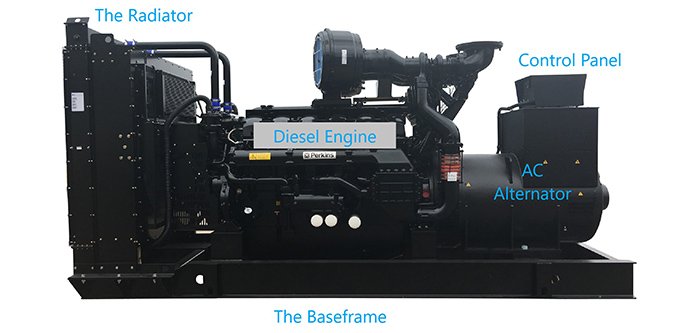
The main components of a diesel generator are:

The diesel engine (how the diesel engine works) provides power to spin the AC alternator (how the AC alternator works), which in turn generates electricity to power the load. The radiator (how the radiator works) also cools the engine to prevent it from overheating. Each of these components parts is made up of a series of ever smaller and more complicated elements, each performing a specific function. For example, the alternator is made up of the alternator main stator, the alternator main rotor and the alternators excitation system. The excitation system is made up of yet smaller parts – the alternators exciter stator, the alternators exciter rotor, an AVR and some diodes. All these smaller parts perform essential functions to maintain the power output of the generator.

What voltage does a generator produce?
A generator can produce almost any voltage – as long as it is ordered to produce the voltage required. It can be impossible to change between some voltages without changing some of the components parts, so its important to make sure you buy what you need. For example generators are often available in three and single phase variants. Single phase is usually used for domestic and small commercial premises, whereas 3 phase is used for larger buildings.

How much power can I get from a diesel generator?
That depends….. different sized generators will give different amounts of output. The bigger the generator, the more power you can typically get, but this also becomes more expensive.

What is an inverter generator?
An inverter generator is a special kind of machine. Rather than the alternator feeding the load directly, the power is rectified and then an inverter is used to produce really good quality AC power. Read more about inverter generators.

What is a silent generator?
A silent diesel generator is a generator that has a steel or plastic surround to reduce the noise. See silent generators.

What are the best international generator brands?
The best known brands are probably Caterpillar (USA), Welland UK Power  and Cummins (USA).
