The Pump Industry has a diverse number of operations that require the control of the flow of various fluids in different processes.
For over 50 years, thermoplastic valves have been growing in acceptance as an effective choice over metal valves in many applications. The advantages of thermoplastic valves include:
- Thermoplastic valves are dielectric, so they do not support an electrical charge. This enables them to be immune from the electro-chemical corrosion that occurs with metal valves.
- Thermoplastic materials are immune to microbiological-influenced corrosion that leads to rust and pitting in metal valves.
- Interior walls are moulded with a smooth finish that enables high flow coefficient and consistent performance over an extended service life.
- Up to 50% lighter in weight than metal valve counterparts. This allows for lower freight and handling costs, and ease of installation.
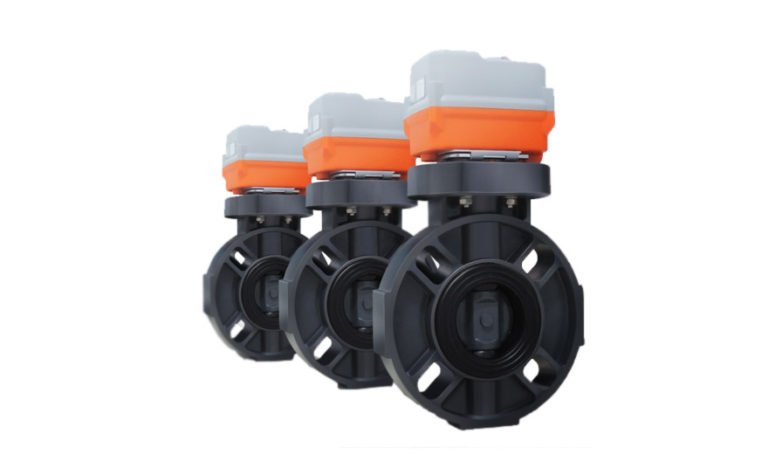
Thermoplastic valves have the advantage of being lightweight, corrosion resistant, chemical resistant and non-toxic. They also will not scale or rust and have low thermal conductivity. Commonly used in municipal and industrial chemical feed systems, thermoplastic material is rugged and well-proven for industrial applications when used within the range of the material’s specifications. Thermoplastic valves fitted with electric or pneumatic actuators also allow for automated control and remote access by operators.
Thermoplastic valve materials
The most common materials used in thermoplastic valve manufacturing are PVC, CPVC, GFPP and PVDF. Both materials inherently perform differently at the same operating temperature, pressure, impact and UV exposure.
The thermoplastic valve body is precision moulded from the base material. Thermoplastic valve assemblies additionally have smaller components made of different material that also interact with the liquid process. All of these materials require careful attention during valve selection due to potential chemical compatibility. Incorrect material selection, especially of O-rings and liners, can lead to premature valve failure.
Ball valves use elastomer O-rings made of EPDM or FMP. These are located in the end connections and stem to create a sealing surface between plastic components. PTFE seats on either side of the ball provide a smooth travel and sealing surface for the ball to ride and seat against. Thermoplastic butterfly valves have an elastomer liner that the disc seals into and O-rings made of EPDM, Viton or Nitrile. A thermoplastic butterfly valve also has a stainless steel or titanium shaft that holds the liner and disc assembly in place within the valve body.
When specifying a valve for a potentially corrosive application, consulting a chemical resistance chart for the thermoplastic and elastomer material chemical compatibility will ensure correct material selection. EPDM rubber is an elastomer recommended for water, steam, dilute acids, dilute alkalis and alcohols.
All thermoplastic material operating pressure decreases as temperature increases. Maximum operating pressure of a 2-inch ball valve can be 250 psi at 70°F, non-shock. The pressure and temperature curves are different for PVC and CPVC. The same schedule 80 PVC ball valve will have a max pressure of 130 psi at 145°F.
READ: Thermoplastic valves manufacturer, Asahi, acquires its Southern Africa distributor
A valve actuator is the device that “actuates,” or moves, a valve open or closed. It attaches to and works in conjunction with two parts: the valve body and the valve pilot.
Types of actuators
When considering actuating a thermoplastic valve, the following points need to be identified:
- Valve type: ball, butterfly, diaphragm, three-way ball
- Valve size
- Valve operation: on/off, throttling (modulating 4-20 mA), 3-position
- Installation: indoors or outdoors
Electric or pneumatic
Pneumatic actuators require plant-supplied air and come as either double-acting or spring return. Options include solenoid (AC or DC), air filter/regulator, positioner (4-20 mA), auxiliary limit switches, visual indicator and declutchable manual override.
Actuator cycle time is the time it takes an actuator to travel from open to close and is important for preventing water hammer resulting from a valve opening or closing too fast. The cycle time of Hayward’s HRSN2 electric actuator for a 4-inch ball valve is approximately 9 to 13 seconds. Cycle time for a 12-inch butterfly valve is approximately 39 seconds. For electric actuators, this speed is fixed.
Speed of a pneumatic actuator is governed by a solenoid assembly that opens or closes on command and regulates the flow of air into and out of the actuator piston cylinder. Double-acting actuators have air supplied to both the open and close cylinders. On loss of supply air, a double-acting valve will remain in the last position. Fail-safe spring return actuators are used in applications that require a valve to travel to either a full-open or full-close position in the event of loss of air supply. The fail-safe position is selected when specifying the actuator but can be changed in the field, if needed.
Electric actuators –These types of valves are among the most common and the most dependable. They’re capable of quickly operating some of the largest valves, and they’re powered by a single or three-phased electric motor that drives a combination of level gears and spurs. Subsequently, these gears and spurs drive a stem nut, which engages the stem of the valve to open or close it. They often include a declutching mechanism and a hand wheel that allows for manual operation in the event of a power failure.
Manual actuators – Manual actuators use levers, wheels, and/or gears to facilitate movement. Manual actuators differ from automatic actuators, as automatic actuators have an external power source providing the force and motion needed to operate a valve automatically or remotely. For many valves, manual operation isn’t an option, either because the application includes valves in remote pipelines or due to the sheer force required for operation. Additionally, manual actuators aren’t a practical solution for valves located in toxic or hostile environments, and they’re not as useful in applications requiring the safety precaution of allowing for immediate shutdown.
Conclusion
When choosing valve actuators, usage factors are a significant consideration. For example, electric actuators, by nature, require electricity to operate. Pneumatic actuators can operate in temperatures ranging from -4 to 150° F (-20 to 70°C), or in some cases in the range of -40 to 250°F (-40 to 121°C), provided the right seals, grease, and bearings are in place. Electric actuators can operate in temperatures ranging from -40 to 150°F (-40 to 65°C).
Pneumatic actuators are often preferred in hazardous or toxic environments due to their explosion-proof nature, but if there’s a lack of compressed air or a pneumatic actuator is unable to meet other operating specifications, electric actuators may be used.